
Kota Kinabalu and Cintai Mantanani Updates:
January – March 2026
KOTA KINABALU
Training Guides for Safer Seas
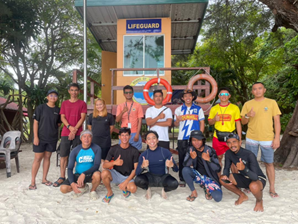
In Kota Kinabalu, 10 new Eco-Friendly Snorkel Guides (EFSGs) recently completed their training in Manukan Island, picking up both safety skills and a better understanding of the marine environment they work in.
With support from Sabah Parks and PBSM, the training covered everything from park regulations to basic lifesaving and water safety, which is the kind of knowledge that makes a real difference out at sea. It’s a simple idea: better prepared guides are able to provide a safer the experience for everyone and better protect the reefs.
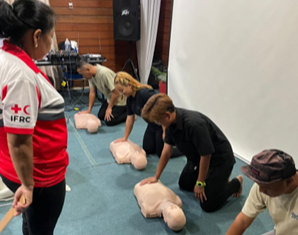
Practical EFR session
Group photo of the participants with Sabah Parks Lifeguard
Shaping Conservation Strategies in Sabah
Our recent engagements focused on both shaping bigger-picture plans and grounding them in real conditions on the ground. On one front, we met with the Ministry of Tourism, Culture and Environment (KEPKAS), alongside Forever Sabah and WWF-Malaysia, to share progress from an ongoing project on marine conservation and fisheries sustainability funded by Oceans 5. The discussion centered on how insights, including those from local communities, can help inform Sabah’s development plans and better integrate marine conservation moving forward.
We also took part in a baseline assessment workshop under the Small Grants Programme (SGP) Phase 8. This session brought together a range of stakeholders to look at the current state of key landscapes and seascapes across northern Sabah, using a ridge-to-reef approach that connects ecosystems from forests all the way to the coast. The insights gathered will guide future funding and conservation priorities under the upcoming SGP Operational Phase 8.
While the first engagement focused on aligning ideas at the policy level, the second looked at understanding conditions on the ground. Both are important steps in shaping more effective conservation efforts in the state.
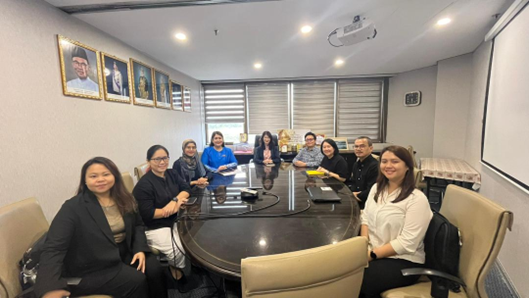
Group photo of the Oceans 5 project team with KePKAS Permanent Secretary, Datuk Josie Lai, and Dr. Maryam
MANTANANI ISLAND
Our colleague Diana took part in a hands-on coral reef restoration programme in Pulau Banggi, learning directly from the local community. She had the opportunity to work with reef stars, apply restoration techniques like MARRS and plant coral fragments on the seabed. Diana also took part in a regional workshop to learn from other marine communities across the Coral Triangle, along withMuhaimin (Redang) and Mulsedi (Selakan Marine Conservation Group member). In Bali, they explored how places like Nusa Penida balance tourism and conservation, gaining practical insights to bring back home. Diana now looks forward to applying her new skills and knowledge back home on Mantanani Island.
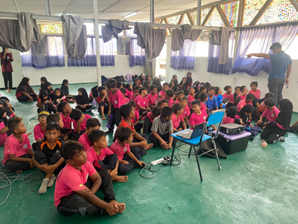
At the same time, back in SK Mantanani, weekly education sessions with students from Year 1 to Year 6 focused on building that same awareness from a younger age. Through interactive activities, students explored topics like marine pollution, the importance of coral reefs, and how everyday actions, like proper waste disposal can affect the ocean.
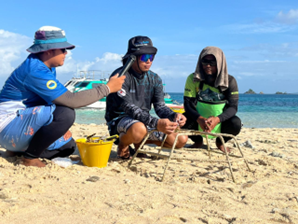
Demonstration of tying coral fragments on the reef star
Education programme with SK Mantanani
That learning continued closer to home in Pulau Banggi, where Diana had the opportunity to work alongside local communities on coral reef restoration. She learnt techniques like coral planting and reef rehabilitation, while drawing from the community’s own experience and knowledge.
These exchanges may be short but impactful and it brings back ideas, skills, and perspectives that continue to shape stronger conservation efforts across our islands.
Checkout these stories
RM205,000 food aid donated by SC Johnson amplifies the need to support remote island communities around Malaysia
11 islands in Malaysia received RM205,000 worth of food aid from SC Johnson, a global manufacturer of household consumer and professional products, with the assistance of Reef Check Malaysia (RCM), to ease the burdens and challenges faced by remote island communities...
Reef Check Malaysia sends another 1,500 kg of trash off Mantanani; calls for more government support
Small, remote islands around the world share the same problem: lack of effective waste management. Malaysia is no exception.Mantanani Island, Sabah (19 July 2021)Reef Check Malaysia (RCM) is currently working alongside partners and local communities to improve the...
Linking resilience, livelihoods and reef management
Reef Check Malaysia is currently operating long-term marine resource conservation programmes in three locations: Tioman island, Mantanani island and the Johor islands. We also have on-going programmes – such as our annual coral reef monitoring survey programme – that...
RM205,000 food aid donated by SC Johnson amplifies the need to support remote island communities around Malaysia
11 islands in Malaysia received RM205,000 worth of food aid from SC Johnson, a global manufacturer of household consumer and professional products, with the assistance of Reef Check Malaysia (RCM), to ease the burdens and challenges faced by remote island communities...
Reef Check Malaysia sends another 1,500 kg of trash off Mantanani; calls for more government support
Small, remote islands around the world share the same problem: lack of effective waste management. Malaysia is no exception.Mantanani Island, Sabah (19 July 2021)Reef Check Malaysia (RCM) is currently working alongside partners and local communities to improve the...
Linking resilience, livelihoods and reef management
Reef Check Malaysia is currently operating long-term marine resource conservation programmes in three locations: Tioman island, Mantanani island and the Johor islands. We also have on-going programmes – such as our annual coral reef monitoring survey programme – that...