


KUALA LUMPUR, 28 APRIL 2025 – The 2024 Malaysia Coral Bleaching Impact Report released by Coralku and Reef Check Malaysia reveals the devastating impact of the 2024 global coral bleaching event on Malaysia’s coral reefs, highlighting urgent threats to marine biodiversity, reef health, and local economies.
These national findings are consistent with global trends. As reported by The Guardian, scientists have confirmed that the 2024 global coral bleaching event is the worst on record, affecting over 80% of the world’s reefs—a trend echoed in Malaysia’s own coral reef data.
In Malaysia, surveys conducted across Peninsular Malaysia and Sabah show that 50.7% of corals experienced bleaching, and an average of 34.1% suffered mortality. The northeastern region, particularly the Terengganu archipelago, was the most affected, experiencing mortality rates as high as 44.2% on average.
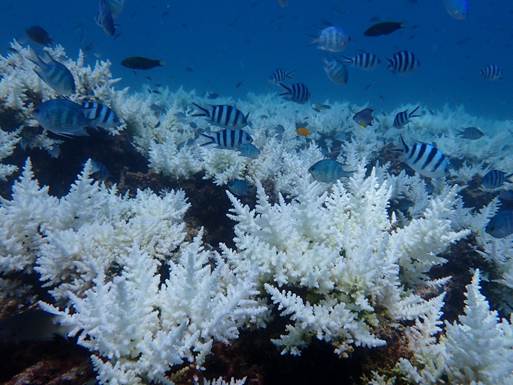
Malaysia faced the 4th mass coral bleaching phenomenon in 2024, and the effect is still felt today by the reefs
“Malaysian coral reefs are at a tipping point,” said Sebastian Szereday, the Founder of Coralku and lead author of the report. “The scale and severity of bleaching observed in 2024 underscores the vulnerability of our reefs to extreme and prolonged heat stress, with profound implications for marine life and reef-dependent communities.”
Szereday noted that unlike previous bleaching events in 2010 and 2019-2020, coral species with complex growth forms—crucial for reef structure and fish habitat—were disproportionately impacted in 2024, leading to a significant loss of three-dimensional reef complexity.
This threatens not only marine ecosystems but also the aesthetic and economic value of reefs, which are vital to local tourism and fisheries. To date, 6 archipelagos within Malaysia’s marine parks are valued at RM8.7 billion according to the Department of Fisheries Malaysia (DoF).
Chen Sue Yee, Science Officer at Reef Check Malaysia and co-lead author emphasized that while halting global warming requires international collaboration, urgent local and national actions are needed to support reef resilience.
“It is vital to take actions to support our weakened reefs. Measures such as eliminating land-based pollution—including untreated sewage, industrial waste, and agricultural runoff—and mitigating coastal development impacts like sedimentation and physical reef damage must be prioritized,” she said.
“We should also promote sustainable tourism to minimize direct physical harm to coral ecosystems and enhance local research capacity and community-led reef co-management. Our findings with Community Marine Conservation Groups (CMCGs) show that these approaches improve awareness, livelihoods, and reef’s health.”
CMCGs have been actively conducting coral bleaching monitoring survey
“Strengthening enforcement of no-take zones and fishing regulations is also essential to reduce exploitation and habitat destruction,” added Chen.
Lee Li Keat, a researcher at National University of Singapore, who is one of the co-authors of the report, suggested that research should focus on expanding standardized bleaching monitoring protocols to identify heat-resilient coral species and sites.
“Understanding the biological mechanisms behind coral resilience can inform restoration strategies and guide new interventions to help corals survive future thermal stress,” he said.
With scientists warning that up to 90% of coral reefs could vanish in the coming decades if warming continues unchecked, the 2024 Malaysia Coral Bleaching Impact Report serves as a stark reminder of what is at stake.
“Malaysia’s reefs are invaluable—not just as ecosystems but as sources of livelihoods, culture, and coastal protection,” the report concludes. “Immediate, coordinated action is essential to ensure they have a future.”
The 2024 Malaysia Coral Bleaching Impact Report is accessible through Reef Check Malaysia and Coralku’s respective websites.
For more information on Reef Check Malaysia, you may visit them on their website, Facebook and Instagram or contact them at hello@reefcheck.org.my.
For more information on Coralku, you may visit them on their website, Facebook and Instagram or contact them at info@coralku.org.
-END-


