
For 17 years, Reef Check Malaysia (RCM) has been synonymous with coral reef health survey data. We built our reputation on being the ones in the water—clipboards in hand, counting indicator fish, invertebrates and assessing substrate types.
Before long, the Department of Fisheries of Malaysia, other agencies and researchers were referring to RCM data when reporting coral reef health, simply because we are the only ones that have a long-term scientific record of coral health in the country, covering over 300 sites annually.
We have accumulated such a vast dataset that we were able to develop a custom dashboard to visualise reef health trends.
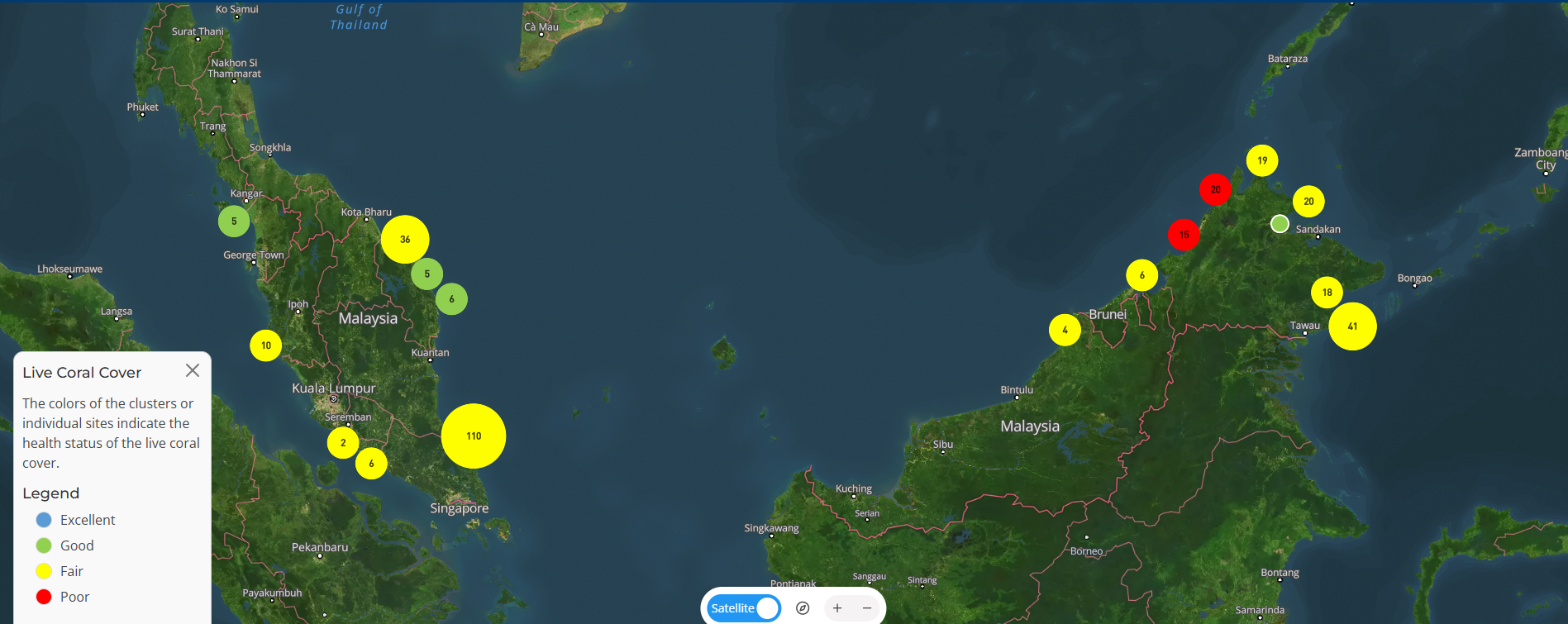
RCM’s interactive map showing reef health in Malaysia
Are We Using Our Data Enough?
But recently, we had to confront a difficult truth: the data, on its own, wasn’t enough to turn red sites into yellow and green; nor preventing good and excellent sites from degrading.
Despite our annual surveys showing the trends, the root causes of coral degradation—specifically land-based activities and pollution—continue to persist.
We realised that to actually use the data effectively, we had to evolve. We had to step out of the water and into policy conversations, where the people and conversations are different. This is where things get a bit complicated.
The Pivot to Policy
In early 2025, we expanded our focus towards policy advocacy. Our goal is not just to monitor a declining trend, but to advocate for the participatory frameworks that could slow down – and possibly reverse – the decline.
We realised that top-down management has its limits; what Malaysia need is a system where local communities are not just bystanders, but active participants, recognised managers of their own resources.
It has been a steep learning curve, but the traction is already visible.
Bringing Marine Conservation to Parliament
We went to the Parliament. Not our natural habitat for sure.
We researched who our 222 Members of Parliament are, narrowed down to those ‘first-tier’ MPs that we want to meet and introduce ourselves to; some know about RCM, some heard about us but are not so sure what we do, nonetheless, they were all very open to getting to know us.
We got to know about the Parliamentary Special Select Committee on Environment, Science and Plantation, met with some MPs who are members of this Committee and eventually the Chair himself. This Committee provides oversight for four key Malaysian ministries to ensure their policies and budgets align with national interests.
These are the Ministry of Natural Resources and Environmental Sustainability (NRES), Ministry of Science, Technology and Innovation (MOSTI), Ministry of Energy Transition and Water Transportation (PETRA) and Ministry of Plantation and Commodities (KPK).
Our message: We are not doing conservation work for the sake of conservation. Not just to report data that we, as a nation, are obligated to report, such as the Convention on Biological Diversity (CBD), to which we are a party. We framed our message that marine conservation, such as what we do, ensures our food security and our economy. That’s the language that policymakers are more familiar with and able to relate to.
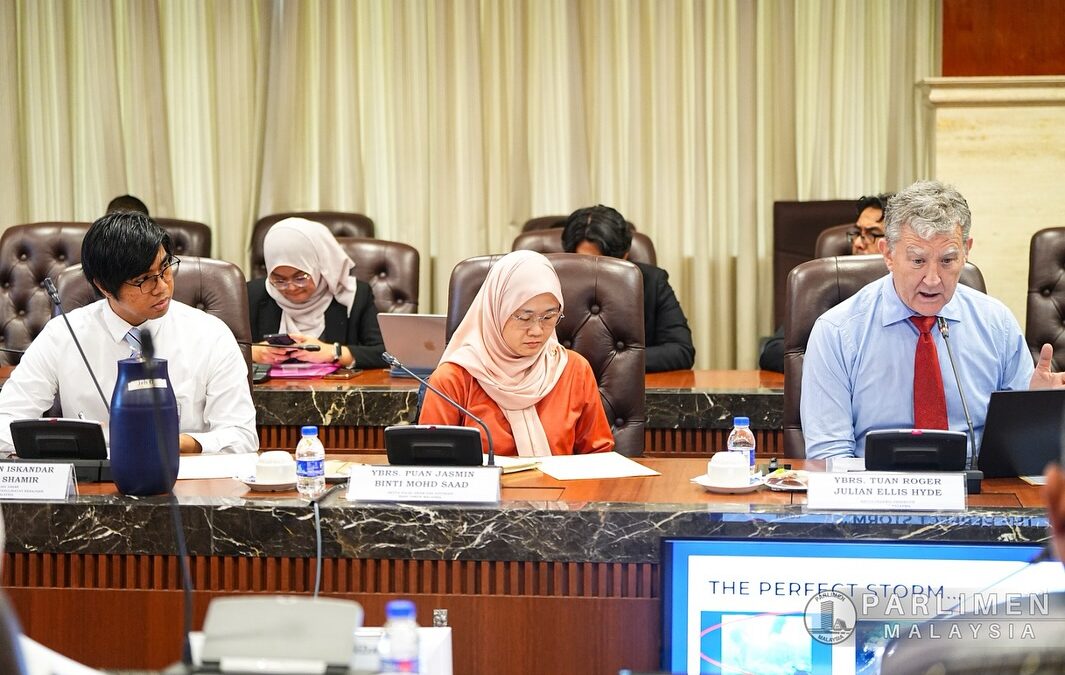
To cut a long story short, on 5 Nov, 2025, we presented our case to the Committee’s meeting, at the invitation of the Chair, Datuk Ahmad Amzad Mohamed. It wasn’t just a presentation; it was a spark.
A week later, we watched as the Chair raised critical questions during a parliamentary session about the link between food security and ecosystem health, encouraging government agencies to collaborate more closely with civil society, such as with RCM!
That moment was a turning point for us. It validated that when we frame conservation not as a luxury, but as a national security issue (food security), the doors to high-level discourse begin to open.
The Institutional Gap
However, this journey has also illuminated the systemic challenges in Malaysia’s governance. The single biggest hurdle we face is the dichotomy between Federal policy and State implementation.
We often see policies set at the Federal level that struggle to find footing on the ground because of jurisdictional silos. Complex challenges like coastal management require multiple ministries and state agencies to work in partnership, yet there is often no formal “table” where they can all sit together.
At least, not that we know of, except for those set up to address issues on an ad hoc basis.
Where We Are Now
So, what have we discovered?
We have learned that progress does not always require new policies; often, it simply requires finding the right “home” within existing structures.
Interestingly, Reef Check Malaysia’s grassroots Community Marine Conservation Group (CMCG) programs—including our CEPA initiatives—have evolved to align seamlessly, almost instinctively, with these frameworks. While RCM’s core focus has always been on community-led conservation, our outcomes directly fulfil the strategic goals of the National Policy on Biological Diversity and the National Agrofood Policy 2.0, spearheaded by the Ministry of Natural Resources and Environment (NRES) and the Ministry of Agriculture and Food Security (MOA), respectively.
It is important to note that while marine and coastal biodiversity conservation falls primarily under the purview of NRES, the management of Marine Parks is supervised by the Department of Fisheries under the Ministry of Agriculture and Food Security (KPKM). This dual jurisdiction requires RCM to navigate carefully between these two ministries.
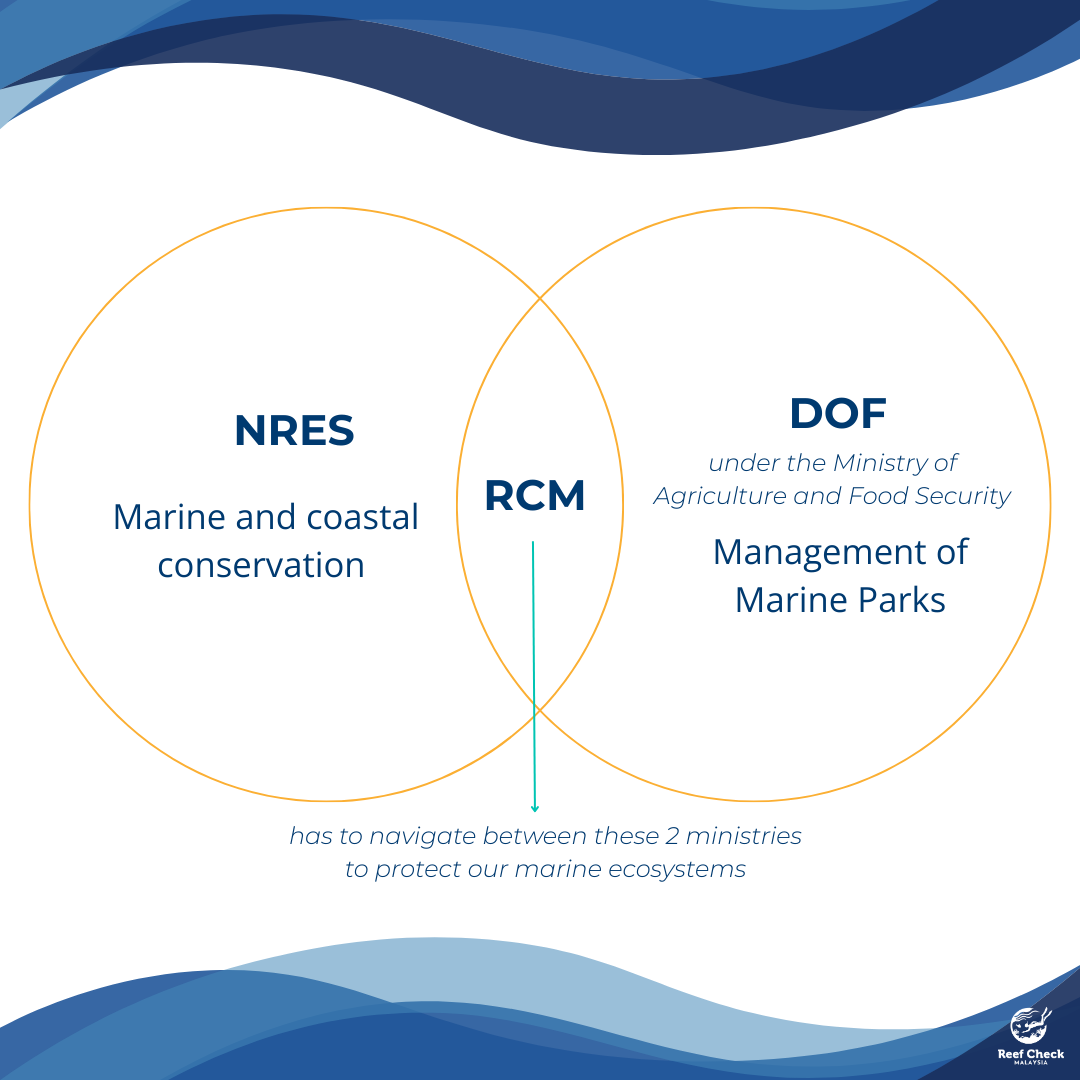
We have to navigate carefully between these two ministries
To address the intertwining of these goals and bridge existing gaps, we are advocating for two critical institutional “links”:
- a Thematic Working Group on Coastal and Marine Ecosystems (as recommended by the NPBD); and
- a National Plan of Action for Small-Scale Fisheries Management (based on FAO recommendations).
These are more than just bureaucratic titles; they are the essential bridges needed to connect Federal ambition with State and local reality.
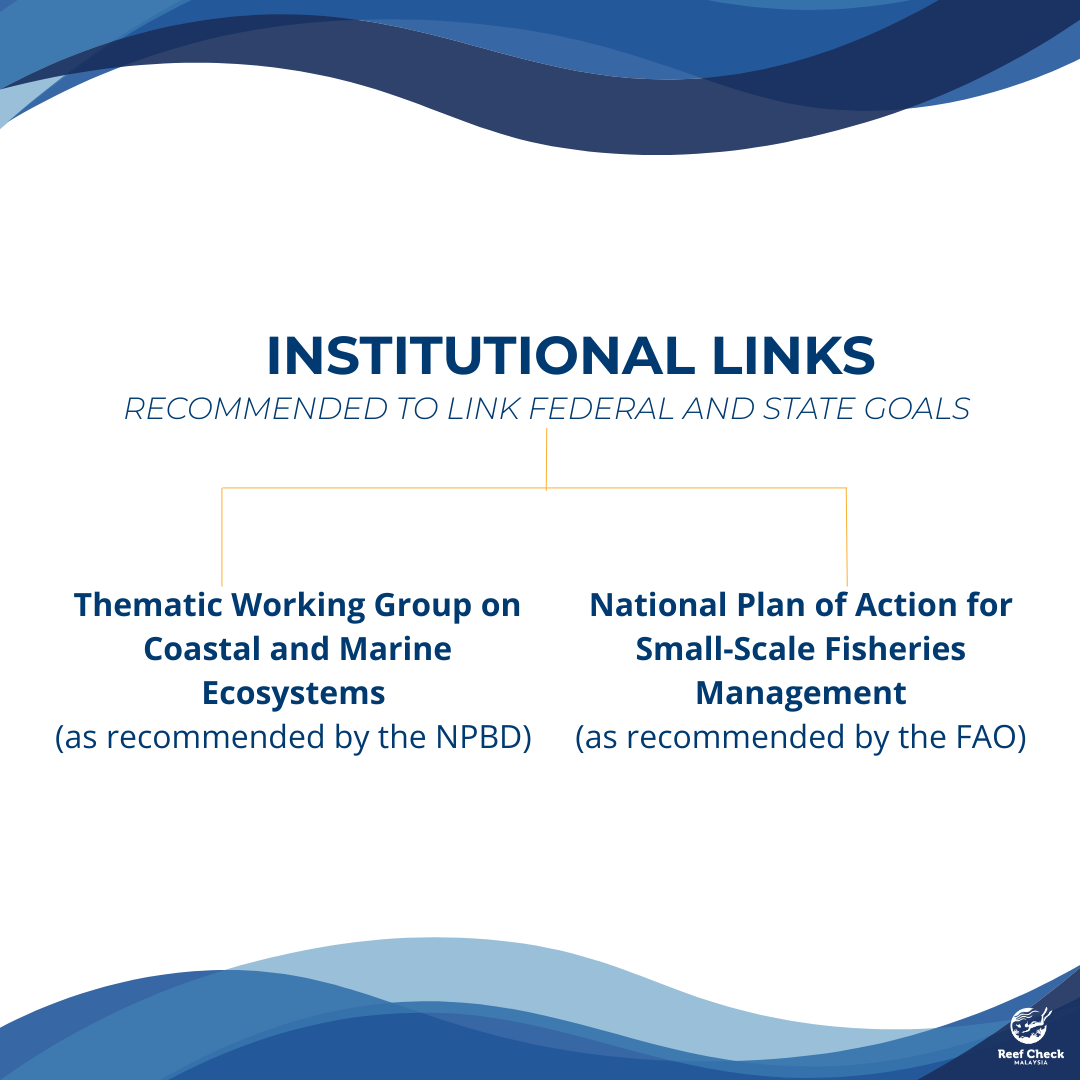
Recommended institutional links
Closer to the ground, to secure a formal “home” for local communities to have a voice within existing structures, we are exploring the District Action Committees (Jawatankuasa Tindakan Daerah) route, advocating for a community-based participatory approach to marine conservation and resource management.
Advised by Members of Parliament and workshop participants, we are evaluating whether this established government structure can serve as the formal platform for CMCG voices to be heard and integrated into official decision-making processes.
The Core Realisation
If I had to summarise RCM’s 17 years of learning into one thought, it is this:
Conservation is not about saving nature for nature’s sake. It is about securing a stronger socio-economic future for the people who rely on it.
Institutionally, this means we must stop viewing local communities merely as beneficiaries of policy. They possess the local knowledge and cultural insights that central planners lack. They must be recognised not just as participants, but as influencers in the decision-making process.
To the decision-makers and partners reading this: We need to shift our perspective.
We need to appreciate the environment not just for its aesthetic value, but for its role in putting food on our tables. We are working to build the institutional bridges within existing structures to make this possible—and we invite you to join us in crossing them.
If you’d like to support us, you can follow our social media pages for any updates on our work and volunteering opportunities, or you could also donate towards our cause.
Connect With Us
- Reef Check Malaysia, Lot 5.19-5.22, Jalan Ampang, Kuala Lumpur, Wilayah Persekutuan Kuala Lumpur, 50450, Malaysia
- 03-2161 5948
- hello@reefcheck.org.my
- Box 606, Lot 5.19-5.22, Wisma Central, Jalan Ampang, 50450, Kuala Lumpur.
Follow Us
Join Our Community
All right reserved, 2025 – Reef Check Malaysia