The AVPN Global Conference 2026
I’ve had the privilege of attending some very interesting conferences lately.
First up was the AVPN Global Conference 2026 in New Delhi in August. For a small organisation like ours, being part of a gathering of this scale is both a privilege and a great opportunity. I’m very grateful to AVPN for giving us a spot as one of their ImpactCollab partners.
It was quite something to be in the same room with changemakers, investors, philanthropists, policymakers and innovators from across Asia and beyond. There were plenty of interesting conversations, different perspectives and, as is usually the case at these events, a lot to think about afterwards.
Valuing and Protecting Biodiversity: The Impact of TNFD Masterclass
Back in Malaysia, I recently had the opportunity to talk about something which, at first glance, might seem rather removed from the world of business: biodiversity. I was invited to conduct a Masterclass at the National Climate Governance Summit (NCGS) 2026.
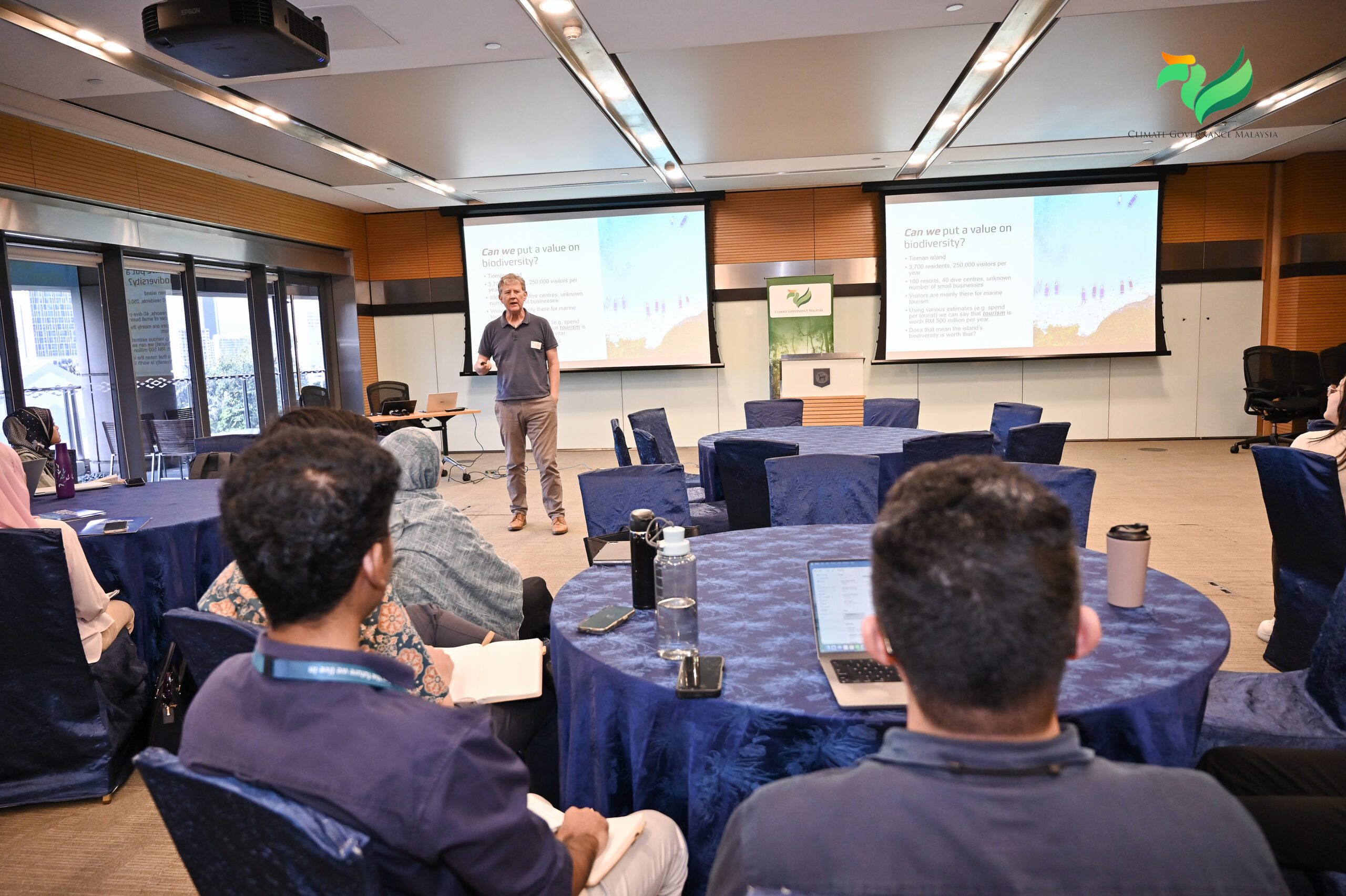
Delivering a Masterclass at the National Climate Governance Summit (NCGS) 2026
I started by asking a fairly simple question: why should biodiversity matter to a business that doesn’t have a physical footprint in nature? A creative agency, a consultancy, a bank… what has nature got to do with them?
Quite a lot, as it turns out.
I’m not a great fan of trying to put an exact price on nature. How much is a coral reef worth? What is the value of a mangrove? You can come up with numbers, but they are ultimately rather arbitrary. A better way of looking at it, I think, is to ask what we lose when those ecosystems are damaged.
Take Tioman. Tourism brings in around RM500 million a year, which sounds like a pretty impressive number. But that doesn’t capture the freshwater provided by the forests, the fish nurseries in the mangroves and seagrasses, the carbon stored in thousands of years of rainforest growth, or the protection provided by the coral reefs. In other words, the reef is doing a lot more for us than providing somewhere nice to go diving.
And this isn’t just an environmental issue. More than half of global GDP depends directly on healthy ecosystems. In Asia-Pacific, the figure is even higher. So, when nature is damaged, businesses don’t somehow sit outside the problem. They are part of the same system, whether they realise it or not.
This is where things like TNFD come in. We have spent decades developing ways of reporting financial information…but only recently developed frameworks for understanding climate-related risks. Now we’re finally doing something similar for nature.
The interesting thing is that you don’t have to be a huge corporation to start thinking about this. A bank can look at the risks sitting inside its loan portfolio. A hotel can look at its dependence on freshwater. Even a small creative business can think about things like its energy use, paper consumption and where its materials come from.
It sounds complicated, and to be honest, it can be. But there are tools like ENCORE that can help businesses start mapping where they depend on nature and where they might be creating risks.
For me, the key point is that this isn’t really about putting a price on biodiversity. It’s about recognising that nature is part of the economic system whether we choose to acknowledge it or not.
And if we don’t understand what we depend on, how can we possibly manage the risks when it starts to disappear?
If you’re interested to watch the Masterclass, you can do so here.
UNEP’s Limiting Overshoot: Navigating exceedance of 1.5°C and pathways towards return report
The UNEP has also recently published a report that puts the focus on something we are all becoming increasingly familiar with: rising global temperatures. The report warns that global temperatures are set to cross the 1.5°C threshold. While this does not mean we should simply accept that 1.5°C is behind us, it does mean that climate risks and impacts are likely to become more severe. The challenge now is to keep the overshoot as small and as short-lived as possible, and to get back below 1.5°C as soon as we can.
The report highlights three areas that need to work together: mitigation, by rapidly cutting emissions, implementing national commitments and reaching net zero; adaptation, by preparing our communities, cities, infrastructure, economies and ecosystems for the impacts we can no longer avoid; and justice and equity, by supporting and empowering the communities that are likely to be affected the most.
I think the last point is particularly important. Mitigation and adaptation have to go hand in hand, but neither can really succeed without justice and equity. The people who have contributed the least to climate change are often the ones who have the least resources to deal with its impacts.
As an organisation, we obviously cannot stop the temperature from rising on our own. But we can play our part in helping communities prepare for what is coming, while reducing the pressures we place on the ecosystems they depend on.
This is where our Community Marine Conservation Groups (CMCGs) come in. We work with local islanders to build their capacity to become leaders in managing their marine resources. They are often the first responders when coral bleaching or other threats affect their reefs. They monitor and rehabilitate ecosystems, respond to threats, and help raise awareness within their communities.
At the same time, we are also helping them develop new skills and alternative livelihood opportunities. This means they can play a more active role in caring for their marine ecosystems while generating additional income, and gradually reduce their dependence on activities that put pressure on those same ecosystems.
In a way, this is what the UNEP report is talking about brought down to the community level. We may not be able to change the global temperature ourselves, but we can help make communities more resilient, give them more options, and put them in a stronger position to care for the ecosystems that protect and support them. And perhaps that is where the bigger climate conversation becomes real: not just in targets and reports, but in what we do with and for the people and places on the frontline.
What’s Next?
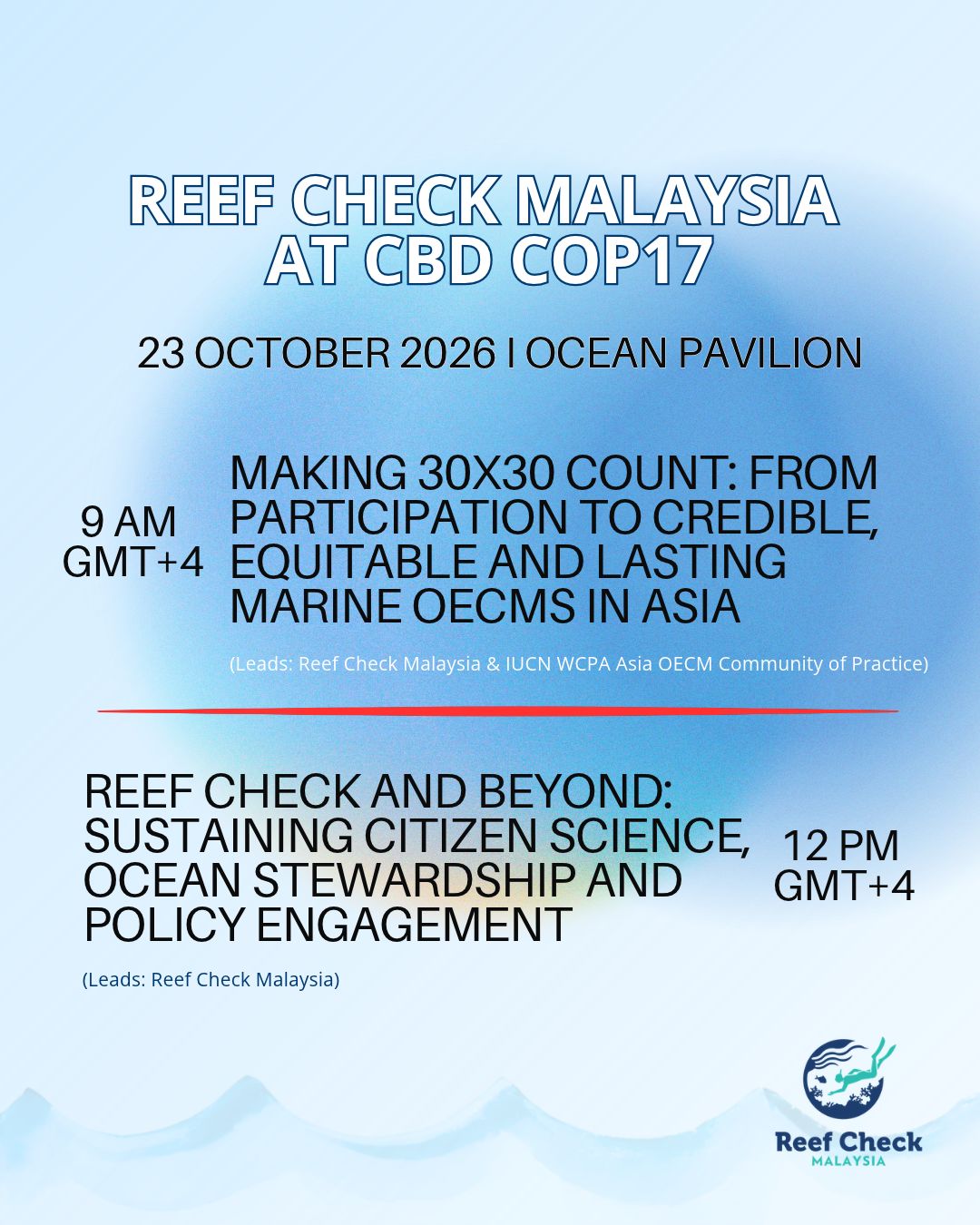
I’m also pleased to share that I’ll be attending CBD COP17 in Armenia, where I’ll be joining the Ocean Pavilion, thanks to the support of Oceans 5, Bloomberg Ocean Initiative, and the Ocean Resilience and Climate Alliance.
Having an Ocean Pavilion at COP17 is significant. Biodiversity conversations can sometimes be dominated by what happens on land, so I’m very glad to see the ocean given a dedicated space to highlight its role in protecting and restoring global biodiversity.
I’ll be speaking in two sessions on Friday, 23 October. The first, at 9am, is “Making 30×30 count: From participation to credible, equitable and lasting marine OECMs in Asia”, which we are leading together with IUCN WCPA Asia OECM Community of Practice.
Then at 12pm, I’ll be speaking in “Reef Check and Beyond: Sustaining Citizen Science, Ocean Stewardship and Policy Engagement”, a session led by Reef Check Malaysia.
Both sessions are closely connected to the work we’ve been doing over the years, particularly around community participation, citizen science and finding practical ways to turn conservation commitments into action on the ground. I’m looking forward to sharing some of what we’ve learned from Malaysia, but also, hopefully, coming away with a few new ideas from others working on similar challenges around the region.