We Live In Interesting Times
I’m sure most people are familiar with the saying “may you live in interesting times”…
I’ve heard if attributed to the Chinese and the Greeks; I’ve heard people use it as a curse and a compliment. But, for sure…we are living in interesting times…if not down-right scary times. But three things have happened in the last week that gave me pause for thought.
A heartfelt plea
The first of the “interesting things” was a post on a list server I follow for coral reef scientists and geeks like me (coz I am not a scientist!!). It went along the following lines (with apologies to the poster for abbreviating it):
- My country of birth is on fire, people dying trying to escape
- Coral scientists from around the world gather in remote New Zealand to talk about what is killing corals…including excessive air travel (the irony)
- Burning fossil fuels…massive El Nino expected to make things worse…more impacts to coral reefs…
- STOP IN PERSON GLOBAL CONFERENCES.
Ok, so this is apocalyptically bad. Wildfires burning across Europe, record-breaking heat waves. And there was pushback from some people on the list, suggesting that no new flights were added, so the planes were going there anyway. And how air travel is but a small part of global emissions. And why should individuals bear responsibility for corporate supply chains…so both sides of the argument were presented.
But, it made me think that perhaps the scale of THIS shock will finally get people to realise we need to change our ways.
But, how can we understand exactly what is going wrong, and how do we prepare?
Systemic failures
Then a couple of days ago I saw this article written by a friend of mine who is way more intellectual and cerebral than I am. I found it a very useful discussion of just why we in the NGO world struggle to get stuff done – particularly the delivery gap test, which I shared with colleagues.
I hope I don’t do the author a disservice by paraphrasing, but he seems to be saying that much of what is happening in the ocean conservation world (and other fields) is not achieving much due to misinterpretation of just what the problems are and how they can be resolved.
He talks about the Octopus model as a way to manage complexity, and the Delivery Gap Test – four questions to assess delivery risks. I have to be honest…reading it made me wonder whether we are part of the problem he is describing. But insightful and very useful and I will be applying it to our own work.
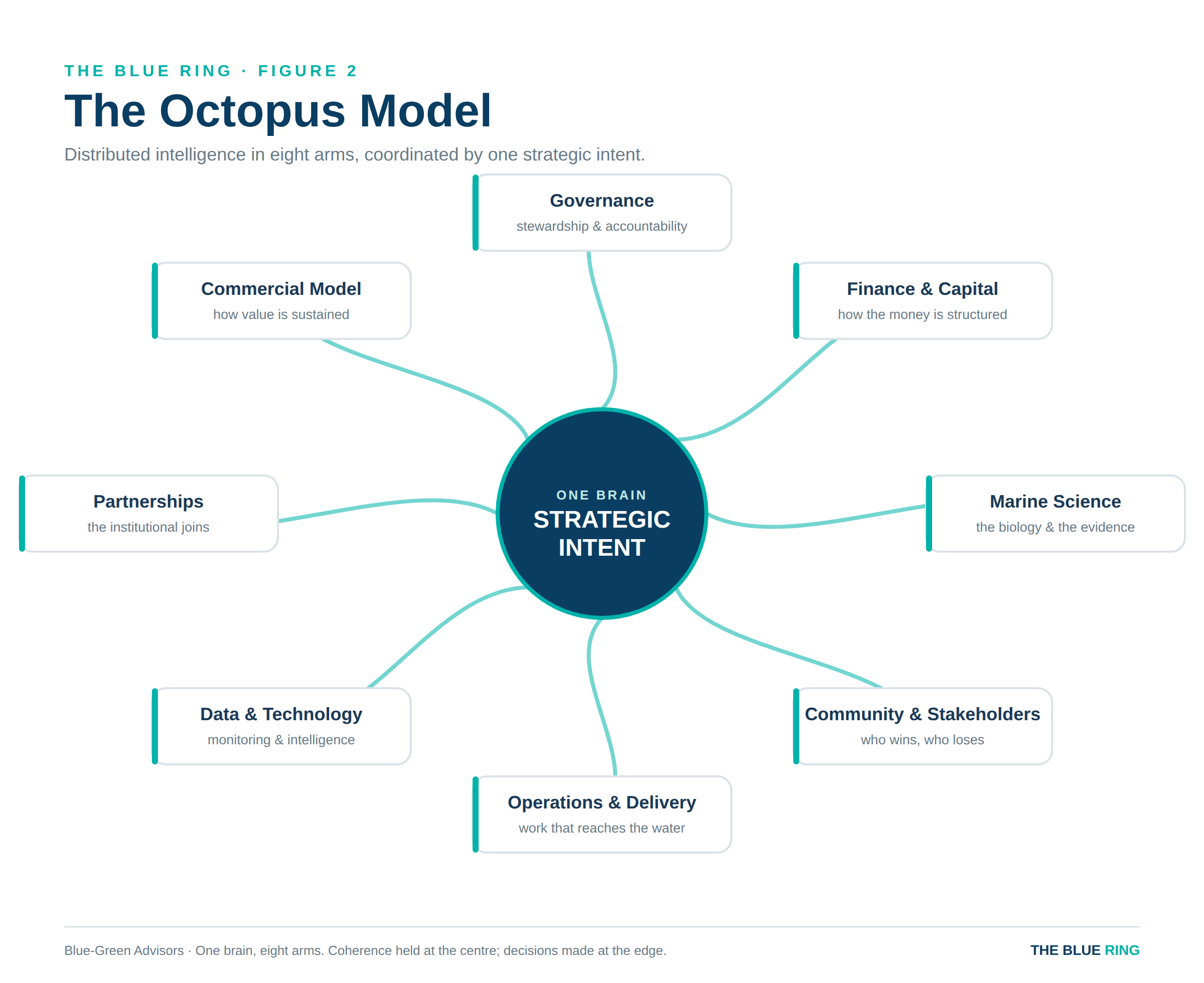
The Octopus Model by The Blue Ring
The forthcoming collapse
And this morning I read an interview with the author of a new book (“I Eat The Stars: How to Live Fully And Beautifully In A Collapsing World” by Sarah Wilson).
Here are my two takeaways:
- First, we are stuck in a mindset which caused the problems in the first place – infinite growth. While we install solar panels our habits are not changing and we are using ever more fossil fuel-based energy.
- Second, there is no conspiracy (this disappointed me😊😊). The tech bros are not out to get us. The real problem lies in the complexity of the whole system, which basically collapses under its own weight – its own contradictions, if you will.
So, is there any hope for us?
Yes!
For me, it is captured in this sentence in the article, spoken by the author (my emphasis added):
“…there’s an opportunity here: what’s collapsing is the post-industrial, colonialist, extractivist, growth-based system. If we tether ourselves to that system, we will go down with it, but if we start to distance ourselves, see what’s happening and refuse to take part in its worst excesses, the better chance we have. The way it’s going, the ultra-rich and the tech bros are going to take everything anyway. The market is going to collapse, the millionaire set will suddenly be without assets, and that’s when revolution happens.”
So, how?
Know any “preppers”? Those people often portrayed by the media as slightly unbalanced, hoarding food, water and other supplies to survive the forthcoming societal collapse? Well, that’s one response.
But, Wilson has a different take: “if things get so bad that you need to be off in the hills with a stockpile of tinned corn and batteries, then you’ll need to be able to defend it with weapons and violence.” Not everyone can – or wants – to do that.
Ok, this bit gets a tad serious, but there’s a point. What is the alternative?
Basically, we need to change our ways.
Yeah, I know. Sounds like hippy wishful thinking, right?
But, look at it this way:If global warming is going to continue to affect us (wildfires…warming oceans…), and if biodiversity loss, climate change, etc. affect food chains…the people with the biggest problems will be those living furthest from nature.
The indigenous peoples will survive because they know how to live off the land. Us city dwellers? What do we do when the supermarkets close? Sure, your average tech bro has built a bunker on an island in New Zealand…but where’s his food coming from??? Not to mention internet, banking system, fuel for his airplane…
If we know this is going to happen (and we pretty much do) then we can prepare. The book talks about what we can do to adapt to what is coming.
Me? I’m learning to grow my own vegetables.
______________________________________________________________________________________
If you’d like to support us, you can follow our social media pages for any updates on our work and volunteering opportunities, or you could also donate towards our cause.